
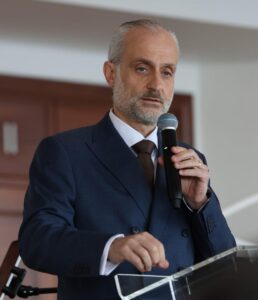
Speech delivered in Monaco on April 29, 2026, during the celebration of the 78th anniversary of Israel’s independence organized by the Monaco-Israel Friendship Association
I would like to speak this evening about a war that is widely misunderstood—because it is viewed from too close a distance.
Since October 7, 2023, people have been commenting on events, analyzing operations, reacting to images. But they forget to ask the essential question: where does this war come from?
The answer is clear.
The primary source of violence and instability in the Middle East today is the Islamic Republic of Iran.
For more than forty years, this regime has pursued a structured project: to eliminate the State of Israel and to impose a regional domination based on a radical Shiite religious ideology.
To understand this project, one must take its ideological foundation seriously.
The doctrine of the Twelfth Imam—the Mahdi—is central.
According to this belief, his return will inaugurate an era of universal Islamic domination.
In this perspective, chaos is not an accident. It is seen as a catalyst.
And the elimination of Israel is conceived as a step toward that end.
This vision does not remain at the level of ideas. It translates into strategy.
Iran has built a network of militias and armed groups: Hezbollah in Lebanon, Shiite militias in Iraq, the Houthis in Yemen, Hamas and Islamic Jihad in Gaza.
It finances them, arms them, trains them, and coordinates them.
It is developing long-range ballistic missiles, drones, cyberattack capabilities, and pursuing a military nuclear program.
And in some cases, it exercises direct control over states. Lebanon is the most obvious example. In Iraq, this influence is deeply embedded in the security apparatus and in political life.
What Iran calls the “axis of resistance” is in reality an axis of aggression.
A system of encirclement that we in Israel call the “ring of fire.”
And this ring does not target Israel alone.
The Iranian regime is part of a broader vision, influenced in particular by the ideology of the Muslim Brotherhood: the idea that the disappearance of Israel would be a step toward a broader victory of political Islam over the West, including in its Christian dimension.
Israel is the immediate target. But it is also a frontline.
In this context, one must be very clear on a key legal point.
Israel’s military actions against Iran and its regional militias fall under the right of self-defense, as recognized by Article 51 of the United Nations Charter.
This right is not limited to responding to an ongoing invasion.
It applies in the face of a continuous, structured, cumulative threat.
State practice shows that a country does not have to wait to be struck in a decisive way when it is confronted with a persistent and organized threat.
Israel faces repeated attacks, military encirclement, and a declared intention of destruction.
Under these conditions, claiming that its actions would be illegal is legally false.
The question, therefore, is not whether Israel has the right to defend itself. It does.
The real question is whether democratic countries choose to recognize this reality—or to ignore it.
Western governments must decide: confront the Iranian threat—or attempt to appease it.
Supporting Israel and the United States does not mean agreeing with everything. It means recognizing the nature of the conflict and taking a stand on a matter of principle.
On this point, many European governments have failed.
Under the pressure of internal politics: migration, the importation of Middle Eastern conflicts into public debate, and electoral calculations.
But also under the effect of a systematic campaign to delegitimize Israel.
This campaign is largely financed by Qatar, amplified by social media, and aims to isolate Israel, to normalize hatred against it, and to deny its right to defend itself.
And it has direct consequences: by demonizing Israel, it legitimizes hatred of Jews and puts Jewish communities in Europe and in America at risk.
The facts are documented.
The Wall Street Journal revealed that the former prosecutor of the International Criminal Court, Karim Khan, had been activated and supported by Qatar in his actions targeting Israel.
At the same time, Qatar supported South Africa’s initiative before the International Court of Justice accusing Israel of genocide—even as the South African president supported Mohamed Hamdan Dagalo, accused of war crimes and genocide in Sudan.
And today, it must be said plainly: Israel is accused—wrongly—of genocide.
This is a grave accusation. And it is a reversal of reality.
This extremely serious accusation is used as a political weapon.
Genocide is a crime defined precisely in international law. It requires the intent to destroy a group as such.
That intent does not exist on Israel’s side.
It does exist, however, explicitly on the side of Hamas, Hezbollah, and the Iranian regime, which openly call for Israel’s destruction.
Accusing Israel of genocide while it is fighting organizations that themselves claim genocidal intent is a reversal of reality.
And it is a deliberate reversal that forms part of a strategy of delegitimization.
This is exactly what Natan Sharansky described as the “three Ds.”
Delegitimization—denying Israel’s right to exist.
Demonization—portraying Israel as inherently criminal.
Double standards—judging Israel according to criteria not applied to any other state.
When these three elements are present, one is no longer in the realm of criticism. One is in the realm of defamation.
If one wishes to assess the conduct of a war seriously, one must look at the facts.
The work of John Spencer—former officer in the U.S. Army, director of the Urban Warfare Program at the Modern War Institute at West Point, and one of the most recognized experts in the world in this field—is particularly illuminating.
Spencer shows that in NATO operations against the Islamic State in Iraq and Syria, the ratios between combatants and civilians killed are comparable—and often less favorable—than those observed in Israel’s war against Hamas.
He notes that in intense urban warfare, a ratio of 1 combatant to 9 civilians can be considered, tragically, unavoidable.
According to his analyses, the ratios observed in Gaza are below that threshold.
And above all, he emphasizes that no Western army has faced a comparable situation: extreme density, systematic use of human shields, and a tunnel network extending hundreds of kilometers.
These elements do not make war less tragic. But they show that the accusations made against Israel ignore both the reality on the ground and the fact that this war is conducted within the framework of international law.
In this context, some Western analyses are mistaken.
A recent article in The Economist claims that Israel has abandoned its traditional doctrine of short, decisive wars, that it has become entangled in open-ended conflicts without a clear political outcome, and that it now depends on the United States to bring them to an end.
This reading is mistaken. It describes the symptoms, but it confuses symptoms with the cause. Israel did not choose long wars. It was forced into them.
It realized that its traditional doctrine—deterrence, early warning, and decisive victory—was no longer sufficient in the face of a messianic and genocidal regime prepared to sacrifice entire populations, including its own.
The question, therefore, is not whether Israel “prefers” long wars. The question is whether a democracy can still rely on deterrence against an adversary that turns chaos, militias, tunnels, missiles, and nuclear ambitions into instruments of a strategy of annihilation.
Israel has therefore decided to dismantle the architecture of the threat—the “ring of fire.”
This is a strategic necessity.
And it implies a long war.
A war that requires time, consistency, and solidarity.
Yet this solidarity is insufficient.
It is insufficient in certain Western capitals.
To say, as Catherine Vautrin, France’s Minister of the Armed Forces, recently did, that “France cannot accept either Hezbollah or the IDF” is outrageous. This statement reflects a profound moral confusion: the inability to distinguish between a terrorist organization and the army of a democratic state that defends itself within the framework of international law.
To place on the same level those who deliberately target civilians and those who seek to protect them is not a position of balance. It is an error of judgment.
Western solidarity is also largely absent at the United Nations.
The United Nations was founded by democracies. It is now dominated by autocracies.
Russia—which invaded Ukraine—and China—which challenges the international order and threatens Taiwan—hold veto power. They support Iran.
The Human Rights Council includes among its members regimes such as Iran, China, Cuba, and Eritrea.
Mass violators of human rights sit in a body meant to defend them—and lecture democracies.
Under these conditions, demanding a Security Council resolution to act against Iran makes no sense.
Faced with these challenges, Israel acts.
In the Western world, its main allies are Washington and Berlin.
In Asia, Israel’s two major partners are Tokyo and New Delhi.
India is a leading strategic partner.
Japan is evolving rapidly.
And it is in this context that I will have the honor of serving as Israel’s next ambassador to Japan.
Israel is also developing a strategy that challenges certain assumptions.
The “Global South” is not a homogeneous bloc. It is a fiction.
Israel demonstrates this by developing strategic partnerships with countries such as India and Argentina.
And by taking bold diplomatic initiatives, such as recognizing Somaliland.
The Abraham Accords, for their part, have demonstrated their solidity.
The alignment between Israel and the Gulf monarchies is holding.
Normalization with Saudi Arabia is a realistic prospect.
And this opens the way to concrete projects.
For example, a pipeline project linking the Gulf to the Mediterranean via Israel and Saudi Arabia, in order to reduce dependence on the Strait of Hormuz and limit the risks of energy blackmail.
Israel is also playing a growing role in critical minerals—essential for defense technologies, semiconductors, and the industries of the future.
And Israel is a key actor in the IMEC corridor—India–Middle East–Europe—designed as an alternative to China’s Belt and Road Initiative.
It is a strategic project, supported by the United States and its partners. And Israel occupies a central position within it.
Beyond these strategic considerations, allow me to take a step back before concluding.
In 1942, Stefan Zweig, an Austrian Jewish writer among the most famous of his time, took his own life in Brazil.
He had lost faith in the future.
He believed the world he had known would not survive.
Others before him saw the danger coming—but made a different choice.
Theodor Herzl, at the end of the nineteenth century, understood that Jews could not simply hope.
They had to act.
It was this choice—action rather than resignation—that made possible the rebirth of Israel.
And it is this choice that still obliges us today.
In Israel, we carry on our shoulders more than 3,500 years of history.
This implies a responsibility: to be worthy of that heritage.
Thirty-three years ago, I made aliyah—that is, I chose to leave my country of birth and settle in Israel to take part in building the Jewish state.
I did not know what the future would hold.
But I knew that this was where I had to be.
Today, I have the honor of serving my country—and soon as Israel’s ambassador to Japan.
It is a privilege.
But above all, it is a responsibility.
Because what we defend goes beyond our individual trajectories.
And what we defend goes beyond the Middle East.
What we defend is part of a broader confrontation between the United States and China, between two visions of the international order.
In this confrontation, Iran is not an isolated actor.
It is aligned with Russia and China, which support it politically, economically, and militarily.
Hence the importance of positions and principles.
Every state has a voice, regardless of its size.
And on matters of principle, it is courage and moral clarity that count.
Because at the end of the day, what is at stake is the defense of the free world.
Leave a Reply